Fallingwater: Why Frank Lloyd Wright Designed One of the Greatest Architectural Masterpieces Ever Built
"Some buildings are admired. Others change architecture forever."
Few buildings have influenced architecture as profoundly as Fallingwater.
Completed in 1939 in the forests of Pennsylvania, this weekend house designed by Frank Lloyd Wright has become one of the most studied, photographed, and analyzed buildings ever created.
Nearly ninety years later, architects continue asking the same question:
Why does Fallingwater still feel more modern than many buildings designed today?
The answer goes far beyond its famous waterfall.
It lies in the extraordinary relationship between structure, landscape, proportion, materiality, movement, and human perception.
The House That Refused to Look at the Waterfall
When Edgar Kaufmann commissioned Wright to design a vacation home, everyone assumed the obvious solution:
Build the house facing the waterfall.
Instead, Wright did something almost unbelievable.
He placed the house directly above it.
That decision transformed the entire project.
Instead of observing nature from a distance, the occupants would become part of it.
The waterfall would never become a postcard.
It would become a constant presence.
Its sound would fill every room.
Its humidity would shape the atmosphere.
Its movement would become the rhythm of everyday life.
This single decision redefined what it meant to "live with nature."
Architecture Doesn't Sit on the Site
Most houses occupy land.
Fallingwater appears to grow from it.
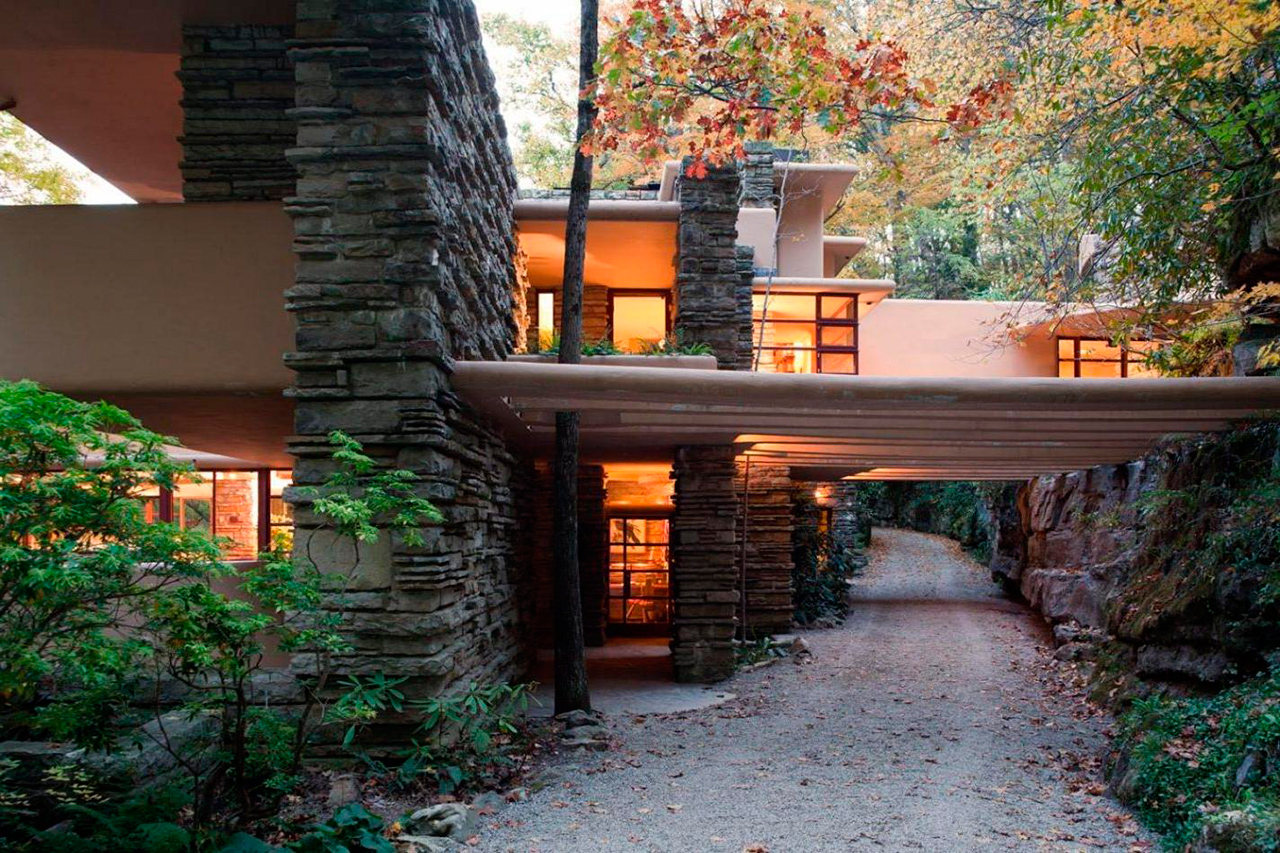
The stone walls rise directly from existing rock formations.
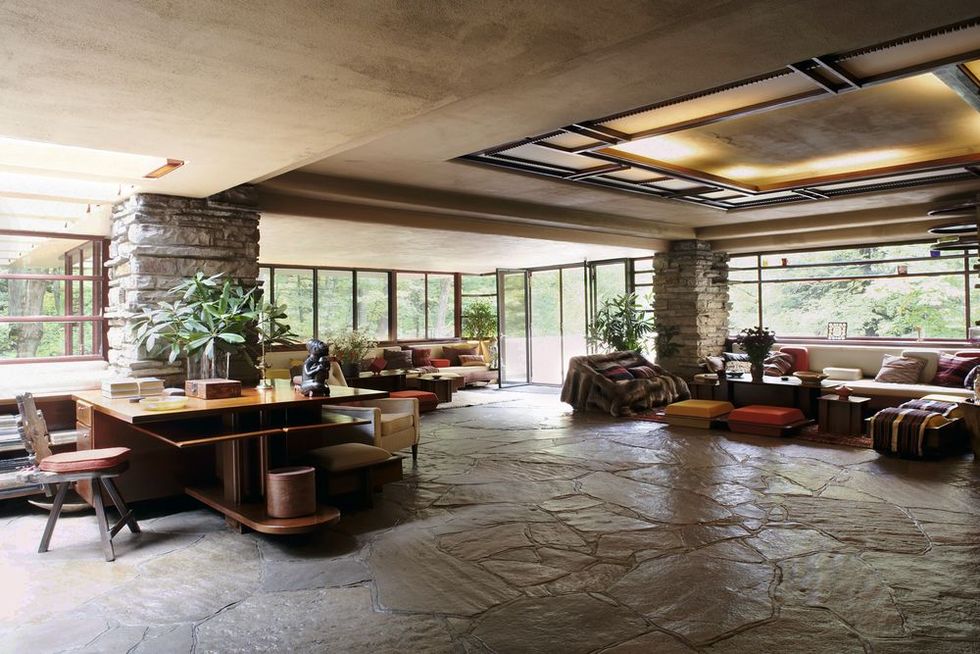
Large boulders inside the living room were never removed.
One of them even becomes part of the floor itself.
Rather than clearing the landscape, Wright allowed the landscape to dictate the architecture.
This philosophy became known as Organic Architecture.
Not because buildings imitate trees.
But because every element responds naturally to its environment.

The Most Famous Cantilevers in Residential Architecture
Perhaps the building's most recognizable feature is its series of dramatic horizontal terraces.
These are not decorative balconies.
They are enormous reinforced concrete cantilevers projecting over the waterfall.
In 1939 this represented an extraordinary structural challenge.
Each terrace appears to float effortlessly, emphasizing horizontality while contrasting with the strong verticality of the surrounding forest.
The visual effect is remarkable.
The house feels simultaneously:
- heavy
- light
- anchored
- floating
Very few buildings achieve these contradictions successfully.
Structure as Architecture
One of Fallingwater's greatest lessons is that structure is not hidden.
It becomes architecture itself.
The cantilevers define the entire composition.
Stone walls act as visual anchors.
Concrete slabs establish rhythm.
Glass dissolves boundaries.
Every structural decision contributes directly to spatial experience.
Nothing feels arbitrary.
The Geometry Nobody Notices
At first glance the house appears completely free.
Almost spontaneous.
In reality, it is governed by an extremely disciplined geometric order.
Horizontal planes dominate every composition.
Vertical stone masses interrupt that movement at carefully calculated intervals.
Corners frequently dissolve into uninterrupted glass, removing the traditional idea of enclosure.
The result is continuous visual flow.
There is almost no moment where the eye completely stops.
Architecture guides perception almost like cinema.
Wright Designed Movement, Not Rooms
Traditional houses organize space into isolated rooms.
Living room.
Dining room.
Hallway.
Bedroom.
Fallingwater rejects this logic.
Instead, Wright designs sequences.
Compression.
Expansion.
Light.
Shadow.
Low ceilings suddenly opening into dramatic spaces.
Terraces appearing unexpectedly.
Views constantly changing as people move through the house.
Architecture becomes choreography.
The building isn't experienced from a single photograph.
It is experienced through walking.
Materials That Belong to the Landscape
Wright deliberately limited the material palette.
Natural stone.
Reinforced concrete.
Steel.
Glass.
Warm wood interiors.
Nothing competes with the forest.
Even the color chosen for the concrete echoes the surrounding rock.
The objective wasn't contrast.
It was continuity.
This restraint explains why the house still feels timeless today.
Engineering Challenges
Ironically, one of the building's greatest architectural achievements also became one of its biggest engineering problems.
The spectacular cantilevers experienced greater deflection than expected after construction.
Over the decades engineers monitored increasing movement.
In the early 2000s an extensive structural intervention introduced post-tensioning cables hidden within the slabs to stabilize the terraces while preserving Wright's original vision.
The restoration itself became a milestone in architectural conservation.
It demonstrated that preserving modern architecture often requires sophisticated engineering equal to—or greater than—that used during original construction.
Light Without Dominating
Unlike many contemporary glass houses, Fallingwater doesn't use transparency to impress.
Glass exists for one purpose:
To eliminate the barrier between interior and exterior.
Corner windows meet without visible structural interruption.
Natural light changes continuously throughout the day.
Reflections merge architecture with forest.
The result is not a house surrounded by nature.
It is architecture becoming part of nature.
What Architects Still Learn From Fallingwater
Nearly every generation discovers something different.
Some study:
- proportion
Others analyze:
- structural expression
Others focus on:
- circulation
- material honesty
- organic design
- landscape integration
That is perhaps the greatest measure of architectural success.
A building that continues teaching decades after its completion.
Why It Remains Relevant in 2026
Today's architecture faces enormous challenges:
- climate change
- biodiversity loss
- urban density
- carbon emissions
- technological dependence
Fallingwater reminds architects that innovation is not always about creating more technology.
Sometimes innovation comes from asking a simpler question:
How can architecture belong to a place instead of dominating it?
That lesson is arguably more relevant today than when the house was built.
Final Reflection
Many buildings become icons because they are beautiful.
Fallingwater became an icon because it changed the way architects think.
It transformed a house into a landscape.
Structure into sculpture.
Engineering into poetry.
Nearly a century later, it continues proving that great architecture is not measured by its size or budget—but by its ability to change how we understand space.
#Fallingwater
#FrankLloydWright
#OrganicArchitecture
#ModernArchitecture
#ArchitecturalAnalysis
#ArchitectureLovers
#IconicBuildings
#ArchitectureDesign


Comentarios
Publicar un comentario